

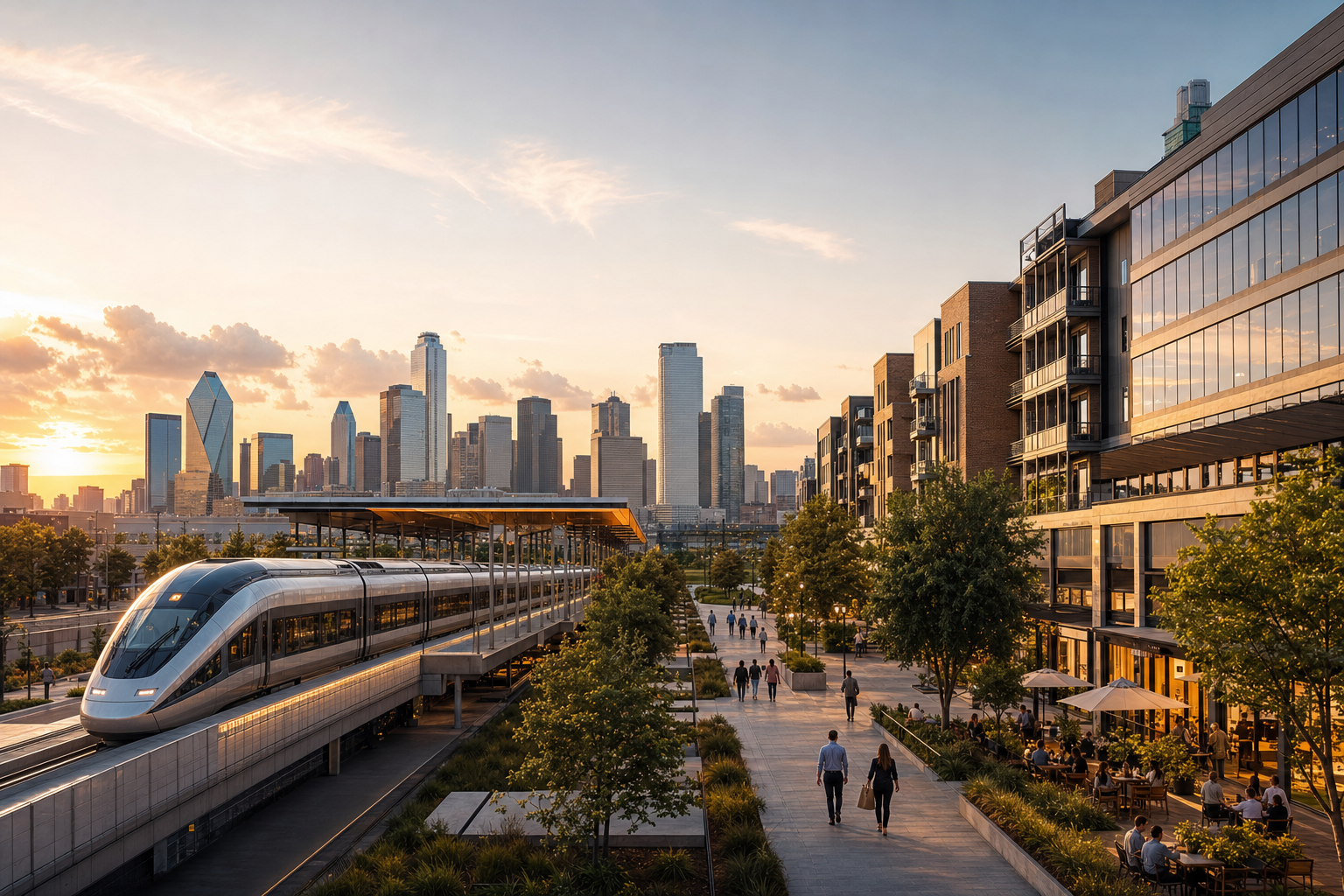
In North Texas, transportation is no longer just a mobility issue. It is a real estate issue, an economic development issue, a housing affordability issue, and a quality-of-life issue.
That is why the latest conversations around high-speed rail, DART’s 2045 Transit System Plan, and transit-oriented development matter far beyond the train platform. These plans are not only about how people move. They are about where companies invest, where families can afford to live, how workers reach jobs, how visitors access entertainment districts, and how cities compete for long-term growth.
North Texas is growing fast. DART’s long-range planning notes that the region is expected to add nearly 4 million residents and about 2.2 million jobs by 2045. That kind of growth cannot be handled by roads alone. More lanes may help in select corridors, but land is limited, construction costs are high, and congestion still affects productivity, commute times, housing choices, and family life.
The real question is not whether North Texas will grow. It will. The question is whether that growth will be connected.
Rail Creates More Than a Ride
A recent economic impact study tied to high-speed rail shows why transportation planning should be part of every serious development conversation. Fort Worth and Arlington could see billions in property tax revenue over a 14-year period if high-speed rail connects them into the larger Dallas-to-Houston and statewide passenger rail network.
The study estimates a downtown Fort Worth high-speed rail station could help generate about $3.3 billion in property tax revenue from 2036 to 2050. Arlington could see about $4 billion over the same period. The impact is not limited to property taxes. The study also points to major visitor and resident spending, hotel tax revenue, sales tax revenue, and new commercial activity.
That is the part that matters for real estate. Rail is not just transportation infrastructure. It can become a development anchor.
Stations concentrate activity. They create predictable access. They make office, retail, multifamily, hospitality, entertainment, and mixed-use projects more viable. They also change how developers and employers think about location. A site near reliable transit can serve more people, connect more workers, and support higher-value land use than a site that depends only on parking and highway access.
Transit-Oriented Development Is Already Proving the Point
DART’s own transit-oriented development data shows this is not theory. A University of North Texas study found that development within a quarter mile of DART light rail stations has generated $18.1 billion in direct economic impact across North Texas over the past 25 years. That includes $1 billion in direct impact between 2022 and 2024 alone.
The study also found rent premiums in transit-oriented developments: 10% higher residential rents and 12.6% higher commercial rents compared with properties more than a half-mile from a station. In the 2022-2024 period, DART station-area development directly created 5,295 jobs and more than $428 million in labor income. It also generated $51.5 million in state and local tax revenue.
Those numbers tell a clear story. When transportation and land use work together, the market responds.
That does not mean every station should become the same kind of project. A successful transit district in Dallas may look different from one in Carrollton, Addison, Irving, Plano, or a future Fort Worth-Arlington high-speed rail corridor. But the principle is the same: people value access.
Access to jobs. Access to housing. Access to entertainment. Access to airports. Access to universities. Access to healthcare. Access to opportunity.
The Commercial Real Estate Case
For commercial real estate, transit can strengthen a market in several ways.
It can make employment centers more competitive by expanding the labor pool. It can reduce the pressure to build excessive parking. It can support retail and restaurants by creating steady foot traffic. It can help hotels and entertainment districts capture visitor spending. It can also make older corridors more attractive for redevelopment.
In a region like North Texas, that matters. Fort Worth, Arlington, Dallas, DFW Airport, Las Colinas, Plano, Richardson, Addison, and other employment centers are not isolated markets. They are part of one regional economy. The easier it is to move between them, the more valuable the whole region becomes.
This is especially important for cities that want to attract corporate users, conventions, sports tourism, entertainment, and mixed-use investment. Companies do not only ask about buildings anymore. They ask about talent, commute patterns, amenities, housing access, infrastructure, and whether the location can support growth.
Transit helps answer those questions.
The Residential Real Estate Case
For residential real estate, transit can expand choice.
Not every household wants to rely on a car for every trip. Not every worker wants a long commute. Not every buyer can afford to live close to a job center if the only practical option is a single-family home near a highway. Better transit gives families more ways to balance housing cost, commute time, schools, lifestyle, and access to daily needs.
That is where quality of life comes in.
A home is not just four walls and a mortgage payment. It is the time a parent gets back when a commute is shorter. It is whether a student can reach school or work without needing a car. It is whether a senior can stay connected. It is whether a family can enjoy entertainment, restaurants, parks, sports, and jobs without every opportunity requiring more traffic and more parking.
Transit does not replace neighborhoods. It strengthens them when it is planned well.
A Quote from Ty Williams
“Transit is not just about moving people from one place to another. It is economic infrastructure,” said Ty Williams of RJ Williams & Co. “When families can get to jobs, schools, entertainment, airports, and housing without every trip depending on a car, communities become more affordable, commercial corridors become more valuable, and quality of life improves. Good transit puts opportunity within reach.”
Planning Matters
Of course, transit alone is not enough. The planning around it matters.
High-speed rail, DART expansion, station-area development, zoning, housing policy, parking strategy, pedestrian design, public safety, and private investment all have to work together. A station surrounded by disconnected roads, empty parking, and no walkable development will not create the same value as a station integrated into a thoughtful district.
DART’s 2045 Transit System Plan recognizes this broader issue by connecting mobility planning with growth, land use, service improvements, and future technology. The plan is built around a simple reality: North Texas is adding people and jobs at a pace that requires more than one transportation solution.
That is the right lens. The future of the region will not be solved by one rail line, one highway project, or one development. It will be shaped by how well these pieces connect.
The Bottom Line for North Texas
Transit is easy to debate when the conversation stays abstract. But the economic numbers make the issue more concrete.
Billions in potential property tax revenue for Fort Worth and Arlington. $18.1 billion in direct economic impact around DART light rail stations. Higher residential and commercial rent premiums near transit-oriented development. Thousands of jobs. More labor income. More tax revenue. More options for families.
That is not just transportation policy. That is economic development.
For commercial real estate, transit can unlock value. For residential real estate, it can expand access. For cities, it can support stronger tax bases. For families, it can create more ways to live, work, and participate in the region without being trapped by distance or traffic.
North Texas has a choice. It can keep growing outward and force every new resident, worker, visitor, and business into the same traffic patterns. Or it can build a more connected region where transit, housing, commercial development, and quality of life support each other.
The communities that understand that connection will be better positioned for the next generation of growth.
Explore the full article archive
Browse more RJ Williams & Company articles on buyer strategy, seller guidance, broker responsibility, market updates, commercial real estate, land, investing, and new construction.